SaaS pricing and margin playground
Set your paying customers, monthly growth, churn, three price tiers and your cost per customer. See MRR, ARR, blended revenue per customer, gross margin, a simple lifetime value and a 12-month forecast.
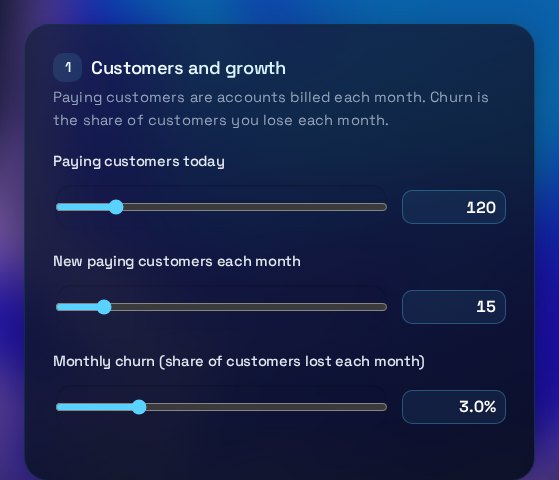
Showing an example: 120 paying customers, 15 new a month, 3% monthly churn and three tiers at $29, $79 and $199. Change any input to test your own numbers.
Customers and growth
Paying customers are accounts billed each month. Churn is the share of customers you lose each month.
Pricing tiers
Set each tier's monthly price and the share of customers on it. The shares should total 100%. If they do not, the tool scales them and shows a warning.
Starter
Pro
Business
Cost to serve each customer
Costs that rise with each customer. Leave out fixed costs such as salaries and rent.
Per customer, per month
Revenue per customer minus the cost to serve gives gross profit per customer.
MRR by month, next 12 months
Bars are relative to the highest month. The table has the exact figures.
How to use the SaaS Pricing & Margin Playground
Enter your real numbers in the order of the sections below. The results update as you type, and the example on the page shows a worked case before you change anything.
What each input means
Paying customers today is the count of accounts billed this month. New paying customers each month is your expected gross adds. Monthly churn is the share of customers who cancel each month. Each tier has a monthly price and the share of customers on it. Hosting and support are your cost per customer per month, and payment processing is a percentage of revenue. Use the same currency for every price and cost.
How to read the results
MRR is paying customers times the blended revenue per customer (ARPU). ARR is MRR times 12. Gross margin is what remains after the per-customer costs, as a share of revenue. Lifetime value is ARPU times gross margin divided by churn, which is a rough guide only. The 12-month table shows how customers, MRR and gross profit move if churn and new sign-ups stay as entered.
Common mistakes
Using list prices when customers pay discounted or annual prices. Leaving out support or processing from the cost per customer, which overstates margin. Entering tier shares that do not total 100 percent. Reading lifetime value at very low churn, where the estimate becomes very large. Treating the forecast as a prediction rather than a what-if, because churn and sign-ups rarely stay constant.
When to talk to an accountant
Ask an accountant before you report MRR or ARR to investors or lenders, especially if you sell annual contracts, offer free trials or bill in several currencies. They can confirm how revenue is recognised over time and which costs belong in cost of revenue. Fixed costs such as salaries and rent are excluded here on purpose and belong in your operating budget.
Three steps
The short version, if you want to get straight to your answer.
- Enter your customers. Set paying customers today, new customers each month and monthly churn.
- Set prices and mix. Set the monthly price of each tier and the share of customers on it. Shares that do not total 100% are scaled, with a warning.
- Add your costs. Enter hosting, support and payment processing costs. Read the margin, MRR and 12-month table as you change any input.
Tips for accurate results
Small input choices change the answer. These are the ones that matter most.
- Use the price customers actually pay after discounts, not the list price. If a discount applies to part of a tier, lower that tier's price to the blended figure.
- Include payment processing as a percentage of revenue, not a flat fee. It rises with price, so higher-priced tiers carry more of it.
- Test churn at two levels, such as 2% and 5%. Lifetime value changes sharply with churn, so the gap is more useful than one number.
- Keep fixed costs out of this page. Gross margin only covers costs that rise with each customer.
- If the tier mix warning shows, fix the shares before you read the margin. The tool scales them, which hides a mistake.
Questions about the SaaS Pricing & Margin Playground
Answers to the questions people ask most often.
How is MRR calculated here?
MRR is paying customers multiplied by blended ARPU. Blended ARPU is each tier's monthly price weighted by its share of customers. ARR is MRR multiplied by 12.
How is gross margin calculated?
Gross margin is revenue per customer minus hosting, support and payment processing costs, divided by revenue per customer. Payment processing is a percentage of revenue, so it rises with price.
How is customer lifetime value estimated?
Lifetime value is ARPU multiplied by gross margin, divided by monthly churn. It is a rough guide. When churn is zero it is not meaningful, so the tool shows a note instead of a number.
How do customers change in the 12-month forecast?
Each month, customers become customers multiplied by (1 minus monthly churn), plus new customers. MRR and gross profit are customers multiplied by ARPU and by gross profit per customer.
What if my tier shares do not total 100%?
The tool scales the shares so they add to 100% and shows a warning. This keeps the blended price sensible, but it means one of your inputs is wrong. Correct the shares so the warning goes away before you use the numbers.
More free tools
Other tools from TRIZAN you might use next.
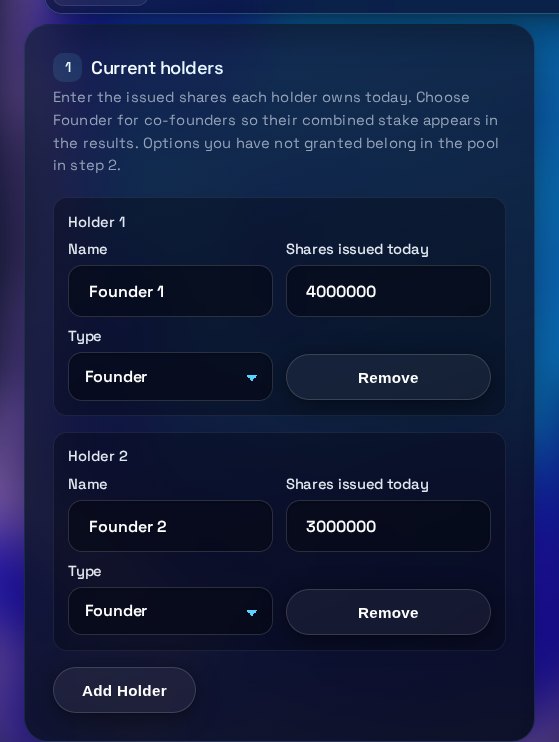 Founders and financeCap Table & Dilution SimulatorModel founder dilution, an option pool top-up and a seed round, with ownership before and after each stage.Open the tool
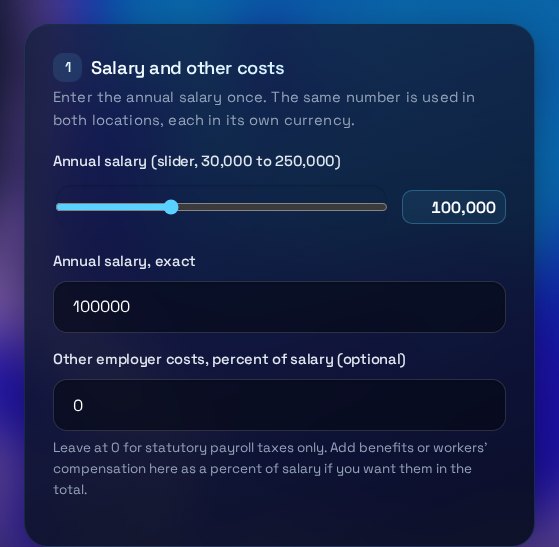 Founders and financeUS vs Canada Hiring Cost CalculatorEstimate employer payroll taxes and full cash cost for a salary in US states or Canadian provinces.Open the tool